MOBILE APPS · SCANBOX
Scanbox: document scanning that does not end at IMG_4471.jpg
Every phone can scan today. Almost none of them solves what follows — names, folders, search by content. Here is what we are building, and why all of it runs on the device itself.
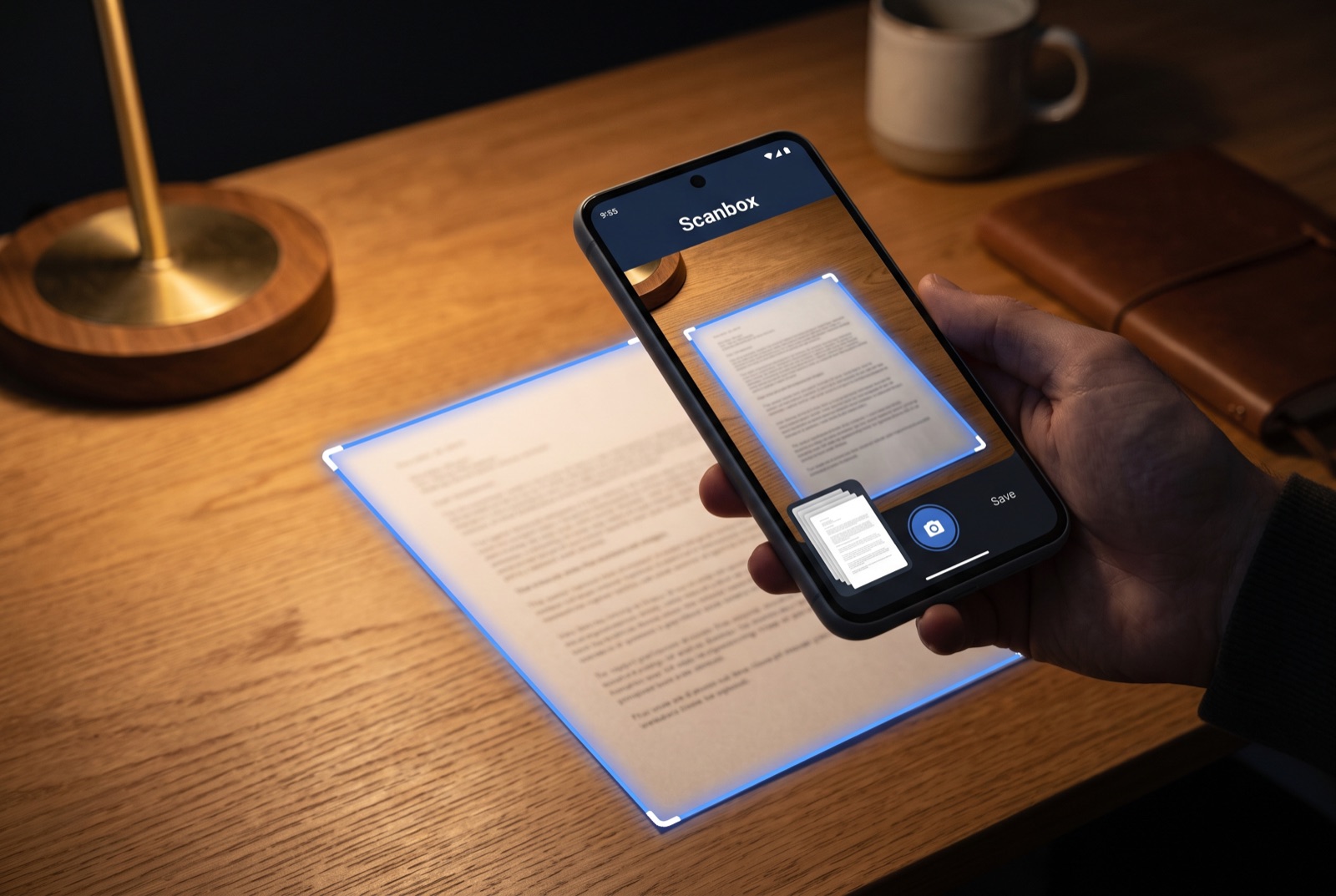
Scanning a document with your phone is a task everybody does and nobody enjoys. The picture is skewed, the edges are cut off, shadows fall across the text, and what comes out is a file called IMG_4471.jpg that nobody can find a month later.
Scanbox is our app that solves both: the quality of the capture and what happens after it. It is currently in development; below is a description of what we are building.
Part 1: Capture — the page has to find itself
The user points the camera and the app has to recognise where the sheet of paper is, live. That happens in four steps, all in real time, at between 30 and 60 frames per second:
- Edge detection. An outline is extracted from the image, and from the outline the quadrilateral that best fits the sheet. The edges are drawn as a frame that sticks to the paper.
- Stability check. The app waits for the hand to settle and only then fires — no shake and no blurred text.
- Perspective correction. A sheet shot at an angle is mapped back into a rectangle. It is the same calculation surveyors use when they align imagery.
- Clean-up. Shadows removed, lighting evened out, text sharpened, and optional conversion to black and white for smaller files.
Shadow detection is the hardest of them. The hand holding the phone almost always casts a shadow across the top of the sheet. The answer is not to brighten the whole image but to even it out region by region — otherwise the white turns grey and the text fades.
Scanbox — documents, scanned and in order
Automatic edge detection, perspective correction, shadow removal, text recognition and PDFs you can actually search.
How we build mobile apps →Part 2: Text recognition
A capture without recognised text is a picture. A capture with recognised text is a document. The difference shows up three months later, when you are looking for the contract with the words “notice period” in it.
Scanbox recognises text on the device and writes it as an invisible layer under the image. The result is a PDF that looks like a photo but can be searched and copied from. For Slovenian that also means handling its accented letters properly — without that, a search for “računovodstvo” is useless.
Part 3: What makes the difference — order
Every phone can scan today. Almost none of them solves what follows. That is why, under the surface, Scanbox is a proper document system:
- Folders and tags defined by the user.
- Search by content, not only by file name.
- Multi-page documents — adding pages, reordering them, deleting a single page without scanning everything again.
- Suggested names based on the recognised text: the date and the heading from the first page are usually enough.
- Sharing by email, to the cloud, or as a password-protected PDF.
Why all of it runs on the device
People scan identity documents, contracts, medical reports and bank statements. Which is exactly why processing in Scanbox never leaves the phone: edge detection, corrections, text recognition and search all happen locally.
There are three advantages: the documents never exist as a second copy anywhere, the app works with no connection, and there is no server cost that would have to be covered by a subscription.
With documents the rule is the opposite of most apps: the less we send onwards, the better the product.
What this means for businesses
The same set of solutions is often needed by companies that have nothing to do with scanning at home:
- delivery notes and work orders from the field, captured on a phone and sent to the office;
- goods receipts with a photo of the document and the order number entered automatically;
- invoices that are captured and sorted instead of somebody retyping the amounts by hand;
- stock counts, where the photo and the quantity are stored together.
In these cases the app is not the goal — the goal is that data from the field reaches the database without being retyped. We have written about how we put the data in order on the other side in the article from spreadsheets to a real database.
If you need something similar
Write and tell us what kind of document is produced in your field work and where it ought to end up. From that it is quickly clear whether you need an app or merely a better form — and we will talk you out of the first if the second is enough.